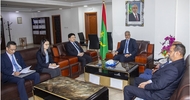
An Israeli delegation is set to visit Cambodia on March 16, hoping to forge agreements in agriculture and telecommunications
- Phnom Penh Post
-
23 February 2009
While I am all for infrastructure projects, the way these large-scale agriculture projects are being conceived leaves a lot to be desired. One, they are shrouded in secrecy. Two, this being Kenya, it is not clear who will benefit most.
- The Daily Nation
-
01 February 2009
Saudi Arabia and the UAE are worldwide leaders in buying farmland in third-party countries, followed by China and Japan, says the World Bank.
- World Bank
-
31 January 2009
Never mind the food miles: when prices are soaring around the world some countries have found a way of keeping their own consumers happy - farming out their farms overseas. One of Asia’s poorest countries, Cambodia, is at the top of their wish list.
- Channel 4 (UK)
-
29 January 2009
Kuwait granted Cambodia a 546-million-dollar agricultural loan in August in return for crop production.
- Associated Press
-
13 January 2009
Some Laotian farmers are losing their ancestral lands or being forced to become wage workers on what were once their fields
Walden Bello said that many of the deals were struck in dysfunctional and corruption-ridden nations, and rejected claims the land being signed away is of poor quality, and that the projects will bring jobs and improve infrastructure. “What we’re talking about is private parties using state contracts to enrich themselves,” he said. “It’s an intersection of corrupt governments and land-hungry nations.”
Los defensores del modelo de poner a producir las tierras desde los gobiernos, inversionistas o grandes corporaciones argumentan que se generan puestos de trabajo, que se hace rendir tierras ociosas y que se producen alimentos. Pero en ese análisis falta el principal elemento. La pobreza en el mundo reside en el campo, precisamente por modelos como éste.
- La Jornada
-
27 December 2008
Des pays en quête de ressources alimentaires et des groupes financiers séduits par les perspectives du marché mondial de l'agriculture acquièrent en masse des terres arables dans des pays le plus souvent pauvres ou émergents, un phénomène qui inquiète des ONG.
The global food and financial crises have combined to create a new form of colonialism in which countries short of resources and corporations desperate for profits are buying up arable land in emerging nations, NGOs say. The non-governmental organisations have expressed concern at this "global land grab," which they say is threatening the survival of rural livelihoods in some parts of the world.
Le Cambodge a annoncé qu’il devrait avoir signé d’ici à mi- 2009 et que les accords concerneraient 2,5 millions d’hectares (l’équivalent de la Bretagne). Notons que le pays continue de recevoir une aide d’urgence du Programme alimentaire mondial, ce qui permet de douter de sa capacité à nourrir à la fois sa population et celle du Golfe…
- Le Nouvel Observateur
-
23 December 2008
Land acquisitions abroad are the only viable response, Mohammed Raouf, program manager of environment research at the Gulf Research Center, and others say.
- The Christian Science Monitor
-
22 December 2008