 The Weekly Times | 28 August 2026
Australian farmland prices soar as global investors chase spectacular returns
Farmland worth more than Australia’s entire superannuation system has quietly outperformed other asset classes for four decades – and the world’s biggest investors have noticed.
by Camille Smith
Spectacular. That’s how leading farmland economist Dr Bruce Sherrick describes the performance of agricultural land as an asset class over the past four decades.
In the US, where Sherrick directs the TIAA Center for Farmland Research, agricultural land was valued at a staggering US$3.7 trillion (A$5.2 trillion) in 2025 and has delivered average annual capital growth of about 6 per cent over the past 20 years. Including farm income and rental returns, total annual returns climb to 12.5 per cent.
“The performance has been so spectacularly good for lots of reasons that in retrospect seem easy to explain, but maybe weren’t quite as obvious when you’re facing the beginning of something,” Sherrick says.
In Australia, the story is similar.
Total broadacre farmland here is worth $1.48 trillion, according to 2025 data from the Australian Bureau of Agricultural and Resource Economics and Sciences.
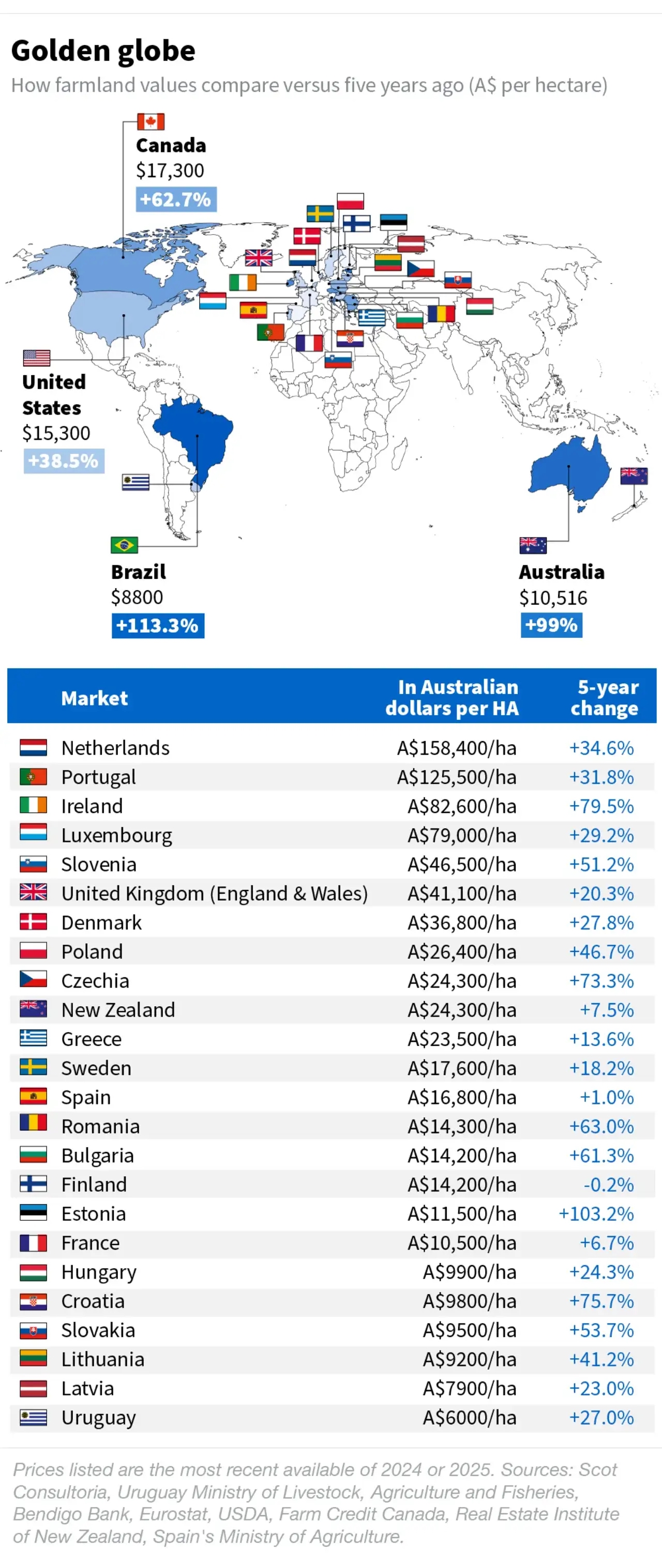
Last year, 6.3 million hectares changed hands – almost the size of Tasmania – at a national median price of $10,516 per hectare according to Bendigo Bank, nearly double the level five years ago.
Bendigo Bank’s Australian Farmland Values report shows 2025 was the 12th consecutive year of growth, with a 20-year compound annual growth rate of 7.2 per cent.
“Supported by a period of low interest rates, this created a robust appetite for farmland expansion, with buyer competition driving prices higher in an environment of limited land supply,” Bendigo Bank head of insights John Droppert says.
The same pattern has emerged globally, says property adviser Savills, which tracks farmland values worldwide.
“Institutional capital is increasingly active, attracted by large-scale farming opportunities and farmland’s history of delivering relatively stable, uncorrelated returns,” says Savills director of natural capital Ed Horton.
WHERE IT ALL STARTED
Sherrick has watched the evolution up close. He grew up on a farm in Ohio, helping his father sow, grow and harvest everything from corn and soybeans to fruit, pigs and sheep.
“I put myself through college with sweet corn,” Sherrick says.
Over a 38-year career spanning agricultural lending, acquisitions, valuations, crop insurance, and academic research at the University of Illinois, Sherrick has seen huge advances in farm productivity, environmental stewardship and land values.
He traces the institutional push into farmland back to the American farm crisis of the early 1980s.
Grain trade disruption and sharp Federal Reserve rate hikes hit the rural economy, causing farmland values to plunge across America’s Corn Belt, triggering a wave of foreclosures throughout the Midwest.
“Institutional lenders to farmland ended up with a lot of farmland as real-estate-owned assets, and as a necessity became farmland managers,” Sherrick says. “It turned out to go better than anybody expected.”
That crisis changed the market. Large investors discovered farmland could deliver income as well as capital growth, diversifying portfolios and providing a hedge against inflation.
“Farm management companies were kind of born out of the crisis, but worked out really well,” Sherrick says. “Everybody else, including the USDA (US Department of Agriculture), stopped just measuring farmland economics and started tracking farmland asset values and rental rates.
“That was the spark that led to the growing interest.”
Sherrick’s research centre was established in 2013, with financial backing from the Teachers Insurance and Annuity Association, or TIAA, whose investment arm Nuveen is one of the world’s biggest farmland investors.
Nuveen Natural Capital manages US$13.9 billion (about A$19.7 billion) of farmland and forestry assets across more than one million hectares in 14 countries. Its biggest exposures are in the US, Brazil and Australia, although it also owns assets in Poland, Romania, Chile and Spain.
Nuveen Natural Capital global head Martin Davies says Poland and Romania are attractive because they are EU members that have productivity potential, land consolidation opportunities and lower land values than Western Europe. Brazil, meanwhile, offers scale, productivity and export competitiveness, while Chile and Iberia provide exposure to high-value permanent crops and counter-seasonal production.
“A common theme across all regions is Nuveen’s ability to establish local teams and execute active management strategies,” Davies says.
WHERE TO NEXT
While Western Europe has generally lagged other regions in value growth, it is home to the world’s most expensive farmland. The Netherlands tops the list at $158,400 per hectare. The northern European nation is one of the world’s largest agricultural exporters – and has all the attributes Sherrick says underpin high farm values: fertile soils, proximity to wealthy populations, competition from other land uses such as housing and renewable energy, and exceptional productivity driven by efficient farming and advanced technology.
Those same factors – along with access to water and the ability to build scale – have made the US, Australia and Brazil especially attractive to institutional investors.
“Where should you invest if you were going to invest for the long term? The exporting potential countries tend to be the easy first place,” Sherrick says. “And if you look at where pensions or other long-term long duration investors are very active, it’s in those three markets.”
Davies agrees, saying Australia is particularly attractive due to its strong property rights, transparent markets, sophisticated large-scale farming and proximity to growing Asian food demand.
“It is a core geography for Nuveen,” he says, with 348,000 hectares under management.
Droppert says Australia’s value growth has been driven by solid farm earnings, high commodity prices and favourable seasonal conditions, particularly from 2019 to 2022.
“Buyers prioritise quality properties with productive soils, good infrastructure and reliable water access, and are often willing to pay a premium for these, especially for neighbouring blocks that enhance existing operations,” Droppert says.
LAWD founding partner and valuations national director Tim McKinnon says the depth of farmland capital growth over the past decade has been remarkable.
“It has been as big capital growth as we’ve seen since probably the 1950s, increasing in value up to three times or more in that period,” McKinnon says. “And that’s been right across the board, across all of Australia.”
McKinnon says Australia’s ability to combine large holdings with strong productivity has made it especially attractive to foreign buyers and high-net-worth individuals.
DIVERSE REVENUE
Investors are no longer looking only at production.
Horton says the next wave of investment is likely to favour land that combines solid farmland fundamentals with opportunities in carbon, biodiversity and other natural capital markets. That shift is already shaping major deals in Australia, such as this year’s controversial sale of Tasmania’s 22,000-hectare Rushy Lagoon.
British natural capital asset manager Gresham House partnered with Aviva Investors to pour $73 million into a trust, along with $69 million from the Clean Energy Finance Corporation, to purchase the property and develop 9000 hectares of it into a pine plantation for harvestable timber and to generate carbon credits.
Gresham House associate director Dorian van Raalte says many funds still show a natural home bias, but a growing number are looking globally and Australia stands out because it offers established ways to monetise environmental outcomes. “This allows investors to consider business models that combine conventional land-based revenues with payments for carbon sequestration, biodiversity enhancement and other ecosystem services,” van Raalte says.
Tasmania’s biggest farm- the 22,000ha Rushy Lagoon.
Tasmania’s biggest farm- the 22,000ha Rushy Lagoon.
HEADWINDS
Despite Australia’s obvious draw, farmland value growth slowed to just 2.8 per cent in 2025.
Droppert says this may signal a turning point, as climate, financial and geopolitical pressures increase.
“There is a potential for the first material decline in the national median price since 2013, especially for farmland in more marginal regions,” he says. “This outlook is influenced by factors such as renewed tightening in monetary policy by the Reserve Bank of Australia, a dry seasonal outlook, surging operational costs … and continued geopolitical and market access uncertainties.”
Sherrick also expects a difficult time ahead, particularly in the US. But he doesn’t think the short-term turbulence changes the long-term outlook.
“There’s a lot of capital moving to the next generation,” says the 63-year-old. “There’s also a lot of family offices or high net-worth individuals who are looking for mechanisms to protect multi-generational family wealth.”
Horton argues productive agricultural land is finite and demand for food, fibre and environmental services will keep rising, driving prices over the long run.
Sherrick sees it differently.
“There’s a great saying that’s always attributed to Mark Twain … and it says you should buy land because they ain’t making any more of it,” Sherrick says.
“But we are. There’s another area the size of Illinois that you could put into production in the southern hemisphere.
“So are we running out? No.”
Nor, he says, is population growth the driving force, because productivity gains have more than kept up.
“To the point we’re growing twice as much corn per acre as we did 25 years ago with half the inputs,” he says. “It’s phenomenal. Never before have we increased our productivity as fast as we are now.”
He says values will continue to rise as nations get richer and people can afford to spend more on food.
“If you want to make farmland valuable, help poor countries get rich faster and help the diet improve,” he says. “That’s the real win.”