 Image: Solidaritas Merauke, 2026At the opening of the International Sustainability Forum (ISF) in Jakarta on October 6, Indonesia President’s Special Envoys, Hashim Djojohadikusumo and Mari Pangestu, announced that the government would no longer be expanding food and biofuel production in forest areas, and that it is committed to ending deforestation for this purpose. Future increases in food and biofuel production will focus on utilising degraded land.
Although government officials have repeatedly expressed their commitment to sustainable development at international forums attended by business leaders, financial institutions and policymakers, this commitment has been reflected minimally in policy programmes and has been weak in practice. As the proverb says, 'It's easier said than done', and this plan cannot be implemented as easily as it is spoken of. Commitment speeches like this often exist only in theoretical discussions and have yet to be implemented in practice.
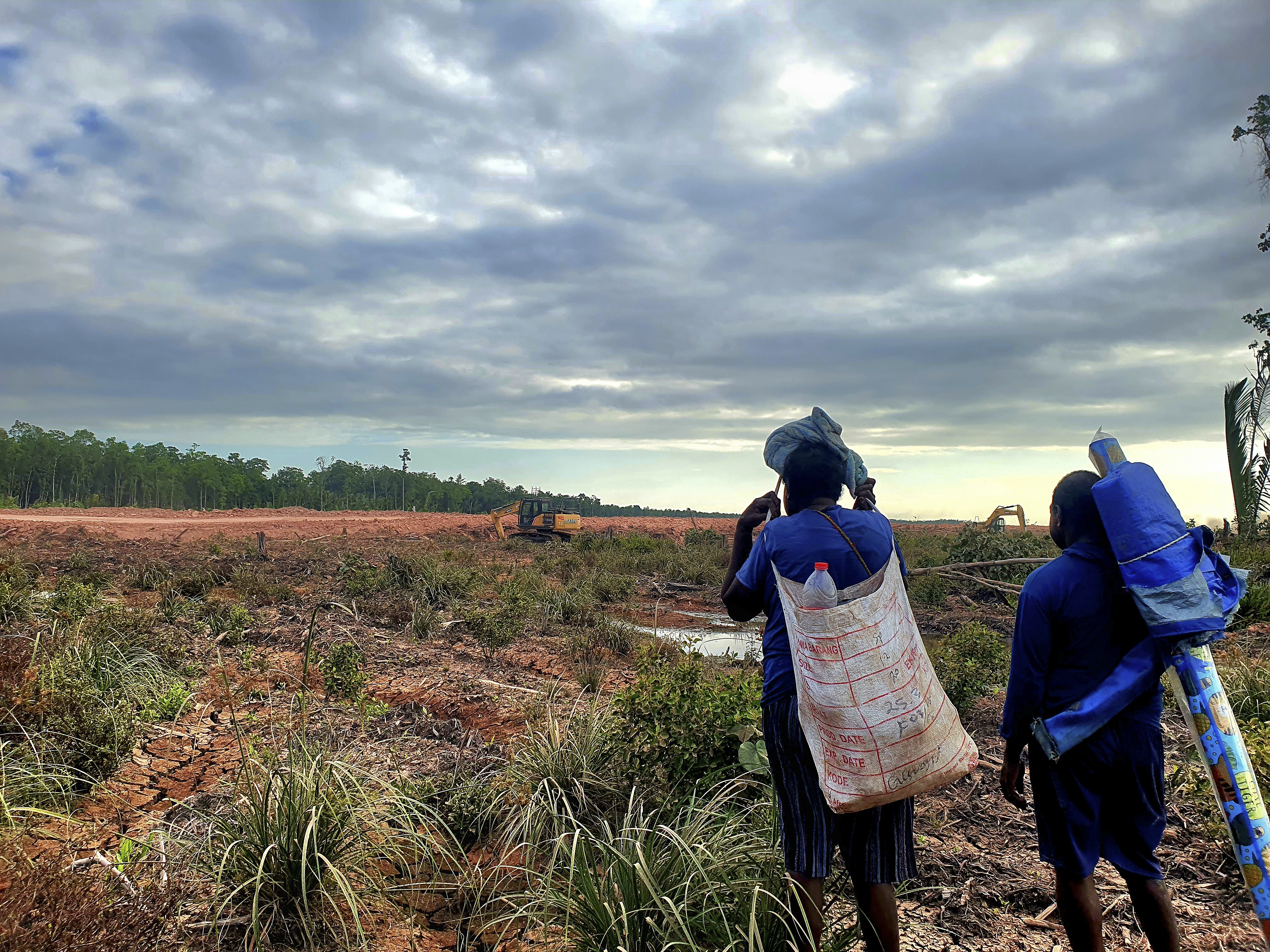
In fact, to this day, vast tracts of natural forest across several regions in Papua continue to be destroyed and cleared by corporate heavy machinery escorted by military personnel. These forests are the target of projects labelled as National Strategic Projects (PSN), including the 'Cetak Sawah Rakyat' (People's Rice Fields) initiative, sugarcane and bioethanol plantations, and oil palm plantations and mills. The local indigenous people, who are the custodians of the land and forests, are being criminalised and have become victims of violence in the name of development, national food and energy security.
According to monitoring by Solidaritas Merauke, the South Papua National Strategic Project (PSN) has covered an area of 49,787 ha through land expansion and deforestation from 2024 to present. Projects undertaken in the name of food and energy self-sufficiency have destroyed lowland forest ecosystems, including swamps and peatlands. This has displaced the traditional food sources and living spaces of indigenous communities, resulting in horizontal conflicts and violence. The onslaught of these large-scale projects has accordingly resulted in the destruction and separation of socio-ecological relationships between indigenous communities and their living spaces, and vice versa. The changes caused by PSN projects extend beyond the reduction in forest cover to encompass water management and biodiversity, affecting local people's livelihoods, cultural practices, food security, health and inherited knowledge, and threatening their survival.
State officials and other commercial actors often trivialise the existence of indigenous peoples and their biocultural knowledge, describing lowland forest ecosystems, with their natural wealth of swamps and savannas, as degraded and unproductive land without anyone living there. This allows the territories to be commodified and become targets for extractive projects and development programmes.
Therefore, Solidaritas Merauke questions the use of the term 'degraded land' when it is defined solely in terms of biophysical measures or economic productivity, without taking into account the area's ecological functions, biocultural values and traditional knowledge. Local communities should be involved in decisions about the development and use of natural resources in their territories. As both rights holders and holders of knowledge derived from generations of living, using, protecting and caring for their land, their input is invaluable.
Solidaritas Merauke sees this announcement as the government's initial response to the struggles of Indigenous People and local communities affected by food and energy projects across the country, particularly in South Papua, which has become a battleground for resistance. This statement should be followed by concrete action, such as terminating PSN Food and Energy projects in South Papua and other parts of Indonesia, as these projects have caused social and ecological damage. The government should immediately issue official policies to this effect, such as revising Regulation of the Coordinating Minister for Economic Affairs No. 16 of 2025 by removing food and energy projects from the National Strategic Projects (PSN) list. Alternatively, a Presidential Decree could be issued to halt the South Papua PSN and take legal action to regulate company activities in this area, thereby preventing the continued destruction of lowland forest ecosystems and the livelihoods of indigenous communities.
Stopping the destruction caused by these projects should be the first step and not the last, one concrete example would be by stopping the construction of the 135 km Wanam-Muting road, revoking Decree of the Minister of Forestry Number 591 of 2025, along with Decree of the Minister of Agrarian Affairs and Spatial Planning/Head of the National Land Agency which granting of Right to Cultivate (HGU) to PT Agrinas Pangan Nusantara, and withdrawing all military troops from Papua.
The government also needs to make efforts to restore the rights of Indigenous People who have experienced violence and lost their land, villages and agricultural land. It must also work to restore the damaged environment. Recovery cannot be defined simply as biophysical rehabilitation or replanting trees. It needs to encompass land and territory, water management and biodiversity, food sources and livelihoods, security, and social and cultural life. It must also address the knowledge and relationships between generations of people living in the land that have been affected. The recovery process must be designed in collaboration with Indigenous People by respecting their knowledge, institutions, rights and decisions regarding their territories.
Solidaritas Merauke calls for fundamental changes to the development paradigm based on unlimited exponential growth, capital accumulation, totalitarianism, extractivism and exploitation. This should be replaced with a regenerative development paradigm based on emancipation and social justice, the respect and protection of human rights, independence and collective action, and the care and the restoration of social and ecological systems, which are interconnected.
Jakarta, 08 October 2026
Contact Person:
Franky Samperante: +62 813 1728 6019;
Teddy J Wakum: +62 822-4245-0431;
Budiarti Putri: +628111463105
Link to Photos of the Real Situation in South Papua PSN Sites: https://drive.google.com/drive/folders/1dmJmjWq2nDH_xqunzucDbqoipj8O7qZr?usp=sharing
Solidaritas Merauke is a broad coalition of Civil Society Organizations and people affected by Indonesia’s National Strategic Projects who fight for and defend the rights of the people and environment.