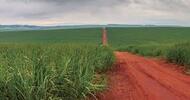
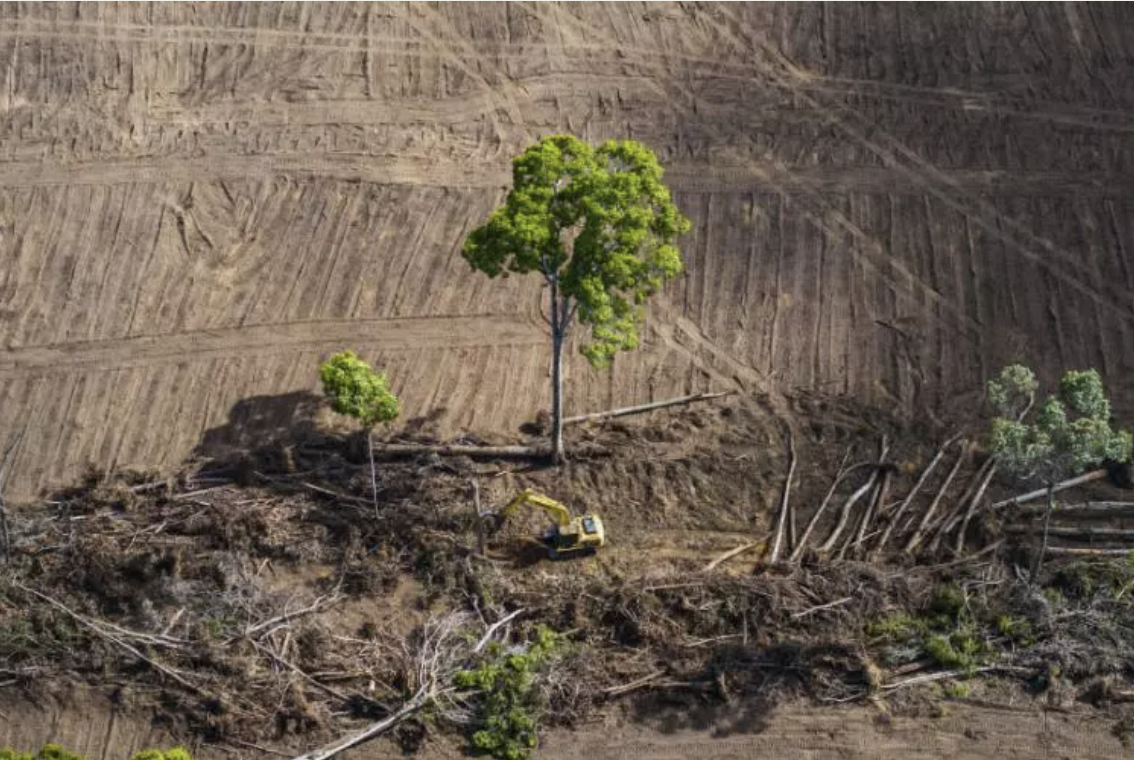
 Forest clearance and sugarcane plantation development in South Papua province, in 2025 (Photo: © Jurnasyanto Sukarno / Greenpeace)WRM Bulletin 280 | 28 September 2026
A common claim is that the ‘energy transition’ will free the world from fossil fuel dependence and, at the same time, improve the relationship between humans and nature. However, in many parts of Indonesia—from Gorontalo on the island of Sulawesi to Merauke on the island of Papua—projects pursued in the name of this ‘transition’ having the opposite effect. These projects involve the production of so-called bioenergy, which is gaining momentum in the country through monoculture schemes that sell ‘clean energy’ but deliver deforestation and destruction.
The report “Legalizing the Climate Crisis”, (1) produced by the environmental organization WALHI, reveals that more than a quarter of Indonesia’s total forest area—approximately 26.5 million hectares—is at risk of being legally deforested in the name of the climate crisis. This is the area for which the government has granted various permits to extractive industries, including the logging, mining and monoculture plantation sectors. (2) With these permits, companies were handed permission to destroy the forests in these areas.
According to the report, these areas are being targeted by companies seeking to undertake ‘energy transition’ projects. This includes companies from the bioenergy industry—biomass and bioethanol—as well as mining companies. To advance their projects, companies are taking advantage of a 2021 government measure that allows ‘forest utilization’ permits—the most common type of permit—to be used to carry out more than one activity within the same concession area. (3)
Taking advantage of this measure, several companies have started to invest in tree plantations for energy production projects (HTE, the Indonesian acronym). This is the case with tree plantations for biomass projects to produce wood pellets, which are used as a complementary fuel in thermal power plants.
Other biomass projects include sugarcane plantations for bioethanol production and oil palm plantations for biodiesel production.
Although companies claim that these projects contribute to the decarbonization of the energy mix in Indonesia, they have in fact caused widespread deforestation and, as a result, increased carbon dioxide (CO2) emissions. Furthermore, they have destroyed biodiversity and appropriated the lands of Indigenous Peoples and traditional communities. Despite this, the Ministry of Forestry legitimizes these activities by classifying this destruction as “legal deforestation”.
The clearance all 26.5 million hectares of forests for which the government has issued permits would cause the same amount of carbon dioxide emissions as has been released by Indonesia’s entire power generation sector over the past 25 years. Not to mention the immeasurable harm that would be inflicted on the forest peoples living in the concession areas. Ironically, deforestation is taking place precisely in the name of projects that claim to be solutions to climate chaos.
From Gorontalo to Merauke, the pattern followed by these projects undertaken in the name of the ‘energy transition’ is the same. First, they sacrifice territories and cause conflict with forest peoples. Second, the licensing process almost always takes place without an adequate environmental and social impact assessment or genuine consultation with the affected population. Third, the ‘green energy’ or ‘clean energy’ label given to these projects obscures the fact that they continue to rely on the large-scale extraction of ‘natural resources’. Fourth, the economic benefits of these projects are reaped by only a handful of large corporations.
Below we set out some specific examples that illustrate how this pattern has played out in practice.
Biomass and the case of Gorontalo: when forests are turned into a timber plantation for energy generation
Monoculture tree plantations for biomass production are booming in Indonesia. Up to November 2025, 1.3 million hectares of land spread across multiple provinces had been earmarked for tree plantations for energy production projects. (4)
On the one hand, this expansion has been driven by domestic demand. By the end of 2022, 35 thermal power plants in Indonesia were already co-firing wood biomass with coal, the primary fuel used in these plants. The government’s goal has been to dramatically increase this number, which reached 52 in 2026. (5) But this practice will neither free Indonesia from its dependence on coal nor help combat climate chaos: the blend used in the power plants is 5 percent wood and 95 percent coal. (6)
On the other, exports of wood pellets have also grown exponentially: from around 100 tons in 2021 to about 120,000 tons in 2023. The main destinations for this material are South Korea and Japan, which also use wood pellets in thermal power plants as a complementary fuel alongside coal. A study shows that 2.3 million hectares of tree plantations would be needed to meet this growing demand.
This is what we might call ‘energy colonialism’. Raw materials are being extracted in Indonesia so that industrialized countries can supposedly become ‘decarbonized’, without taking into account the social and ecological damage caused in the places where these raw materials are sourced.
One of the current hubs for the expansion of tree monocultures for biomass production for export is Gorontalo Province in Sulawesi. According to data from Forest Watch Indonesia, at least 1,100 hectares of forest were cleared in the province between 2021 and 2023 to establish tree plantations for energy generation. And this number is set to increase dramatically in the coming years.
Six companies are in the process of obtaining permits, which could result in more than 180,600 hectares being set aside for the expansion of monoculture tree plantations for biomass production. (7)
Another four companies are setting up tree plantations for energy production projects in a concession area covering 101,500 hectares. (8) Two of these companies, PT Banyan Tumbuh Lestari and PT Inti Global Laksana, operate in areas near the Lomuli and Butungale communities, in the Pohuwato district.
WALHI Gorontalo has conducted research and visited the area to assess the damage these projects are already causing in these two communities. (9)
Impacts of biomass production on the Lomuli and Butungale communities
According to the study, the Lomuli and Butungale communities have suffered extensive ecological and social damage as a result of the biomass projects carried out by PT Banyan Tumbuh Lestari and PT Inti Global Laksana.
The deforestation caused by the projects has already impacted the natural water cycle in the communities. One of the consequences is that rainfall is no longer absorbed by the vegetation, causing excessive surface runoff, shrinking groundwater reserves and increasing the risk of floods and droughts, which is already considerable.
Furthermore, residents reported that one of the companies was filling in the riverbed of a tributary to build a road to transport timber. This also disrupts the natural water cycle and further increases the risk of flooding.
Another impact is that monoculture plantations make the area more vulnerable to insect infestations, diseases and soil degradation. Not to mention that forest species are unable to survive in areas planted with monocultures.
In terms of social harm, communities have lost access to the forest, which is their source of water, food, firewood, honey, rattan, resin, cashew nuts and even arenga palm sap. As a result, cultural practices that depend on the forest are gradually being lost.
There is tension between community members who hope to find work at the companies and those who are suffering from the loss of their land. However, those who find work are currently facing low pay and the lack of legal protections. Far from improving well-being, the arrival of these companies has resulted in a new form of structural vulnerability.
Furthermore, the companies have completely ignored the principle of prior consent without coercion—an adaptation used in Indonesia of the principle of free, prior and informed consent, as it is known in many other countries. All the people interviewed in the communities of Lomuli and Butungale reported that no meetings had been held to clearly inform them about the two companies’ projects. The last meeting they remember took place in 2015, when the companies claimed to be operating monoculture oil palm plantations for palm oil production rather than tree plantations for energy production.
Furthermore, WALHI’s Gorontalo study found that more than 90 percent of the people interviewed in the two villages stated categorically that they rejected the presence of the two companies. This suggests that these projects are being implemented without the communities’ free consent, which is a fundamental right and should be a basic requirement before any land is cleared in areas that impact these communities.
Finally, an investigation into the companies operating in the region harboring the Lomuli and Butungale communities shows that the beneficiaries of these projects remain the same local elites as always. The documents reveal ties between one of the leading wood pellet exporters in the Pohuwato district and various figures in the business world and national politics, including the family network of Astra International, one of Indonesia’s largest and most famous automotive conglomerates.
This concentrated ownership structure reproduces the colonialist model at the local level: timber is extracted from Indonesia and shipped abroad while the economic benefits are concentrated among the political and economic elites and the ecological and social burden is borne by the communities in the area where extraction takes place.
Bioethanol in Merauke: loss of living spaces for Indigenous communities
In the Merauke district of South Papua, Indigenous communities are bearing the impact of bioenergy projects that are part of the Merauke National Strategic Plan (PSN). Arguably the largest ongoing deforestation scheme in the world today, the plan envisages the clearing of approximately 2 million hectares of forest.
Bioenergy projects include monoculture oil palm plantations for biodiesel production and monoculture sugarcane plantations for ethanol production. Sugarcane plantations for bioethanol production are one of the pillars of the National Strategic Plan. Ten companies in this sector have already been granted permits for areas covering a staggering 541,094 hectares spread throughout the Merauke district.
A monoculture sugarcane plantation is currently being planned on the traditional territories of the Yei and Marind Peoples, which are home to 40 villages and more than 40,000 residents. The implementation of this project is ‘top-down’. The community was not consulted and the involvement of the army left the communities feeling coerced, with the government failing to respond to numerous protests by the population.
Meanwhile, the population has witnessed the arrival of hundreds of heavy machines—including more than two hundred excavators—which are destroying villages, vegetable gardens, wetlands and sites that are considered sacred by the Marind Maklew community. All of this is taking place under the direct supervision of the military.
The fact that half of the areas licensed for sugarcane cultivation are protected areas also violates the existing local land use plan, given that these areas should never be used for agriculture. (10)
As in Gorontalo, the sugarcane companies in Merauke concentrate wealth and property in the hands of a select group of large corporations. The same companies that have historically controlled the oil palm plantation industry and global vegetable oil trade. (11)
Why the right to say “no” should be respected
The licensing process almost always takes place without an adequate environmental and social impact assessment or genuine consultation with affected communities. The principle of free, prior and informed consent—the right secured by traditional communities to accept or reject projects that cause harm to their territories—has been treated as a mere formality that can be ignored, rather than as a condition that can effectively prevent a project from being implemented.
When a population voices its opposition to projects that cause severe harm to their territories and their lives—as happened in the communities of Lomuli and Butungale in Gorontalo, and among the Yei and Marind Peoples in Merauke—that voice is ignored and often suppressed through the implementation of security measures.
Ensuring respect for Indigenous Peoples and communities’ right of veto would have a range of concrete ecological benefits. After all, the forest areas that remain intact in Indonesia and around the world are generally those inhabited by Indigenous Peoples and traditional communities.
In other words, strengthening the right of forest peoples to their living spaces is a matter of social justice. At the same time, protecting this right contributes to forest conservation and, consequently, to addressing the climate crisis.
However, in its current form, the so-called ‘energy transition’ has done precisely the opposite in Indonesia, accelerating deforestation, which is also one of the major drivers of climate chaos.
Old-fashioned colonialism under a new guise
From Gorontalo to Merauke, the model used by ‘energy transition’ projects perpetuates old patterns. Instead of providing fair ‘clean energy’, it continues to sacrifice territories that are living spaces for Indigenous Peoples and traditional communities in order to enrich a handful of companies and local elites.
As long as bioenergy projects—such as plantations for bioethanol, biodiesel or biomass production—continue to be implemented without a comprehensive evaluation of how permits are granted, without respecting the right of affected communities to reject these projects and without an environmental and social impact assessment that is committed to social and environmental justice, the claim of ‘clean energy’ is nothing more than old-fashioned colonialism under a new guise.
A truly fair ‘energy transition’ must begin by answering a key question: energy for whom, and at whose expense?
References:
(1) WALHI, 2025. MELEGALKAN KRISIS IKLIM: Deforestasi Sistematis Atas Nama Transisi Energi di Indonesia. Available in Indonesian and English.
(2) The permits include mining business permits (IUP), forest utilization business permits (PBPH) and right to cultivate permits (HGU). More than 65 percent of the area covered by these permits is located on the islands of Sumatra and Kalimantan, while Papua has become the new frontier for the expansion of investment.
(3) This permit is called PBPH in Indonesia.
(4) WALHI, 2025. Hanwa Co., Ltd. Hentikan Impor Bahan Bakar Biomassa yang Merusak Hutan, Hutan Indonesia bukan bahan bakar!
(5) Investortrust, 2026. PLN EPI Targetkan Pasokan Biomassa 3,65 Juta Ton pada 2026, Percepat Co-firing di 52 PLTU
(6) WALHI, 2025. MELEGALKAN KRISIS IKLIM: Deforestasi Sistematis Atas Nama Transisi Energi di Indonesia. Available in Indonesian and English.
(7) These companies are PT Hutani Cipta, PT Keia Lestari Indonesia 1, PT Keia Lestaria Indonesia 2, PT Lumintu Ageng Yoyo, PT Nawa Waskita Utama and PT Sorbu Agro Energi.
(8) These companies are PT Inti Global Laksana, PT Banyan Tumbuh Lestari, PT Gema Nusantara Jaya and PT Gorontalo Citra Lestari.
(9) WALHI, 2025. MELEGALKAN KRISIS IKLIM: Deforestasi Sistematis Atas Nama Transisi Energi di Indonesia. Available in Indonesian and English.
(10) For information on resistance against the Merauke National Strategic Plan (PSN), see WRM, Indonesia: Stop the Merauke National Strategic Project!
(11) Some of these companies use shell companies to conceal the identity of the owner and person who profits from the operation, which is common practice.