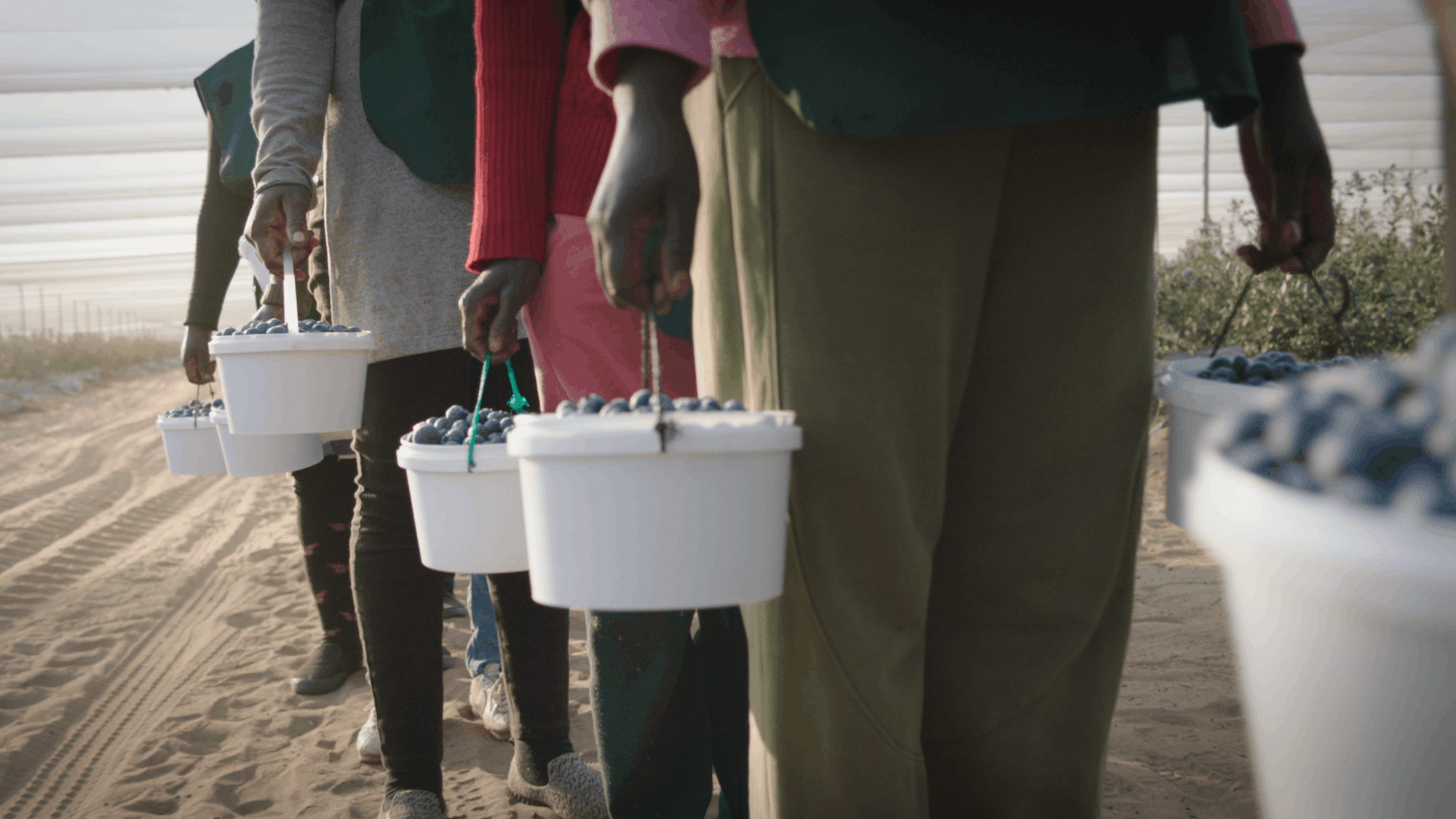
 Workers carrying freshly harvested blueberries at Mashare BerriesBBC | 12 October 2026
The berries and birds reshaping the Angolan economy
(Note: This is a paid-for advertisement by Fundo Soberano de Angola)
On the banks of the Kavango River, in one of Namibia's most remote regions, a woman named Leopoldine Mahongo planted the first blueberry bush anyone in the country had ever grown commercially. In 2019, she had no way of knowing it would grow into a promising export business. "I was very much excited, because we didn't know that it would be a success. It was the first in the country. We [had] never heard about it," she explains.
Today, Mahongo is the production manager of that same farm, Mashare Berries, running thousands of plants and a workforce that runs into the hundreds at harvest. She started as one of the labourers who planted it, and her rise tracks the farm's own. Both took years to build.
Mashare is backed by the Fundo Soberano de Angola (FSDEA), Angola's sovereign wealth fund, which invests in sectors at home and further afield across Africa. Mashare Berries, which trades as Namib Blue, sits in Kavango East, where surprisingly fertile soil, strong sun, seasonal rain and the Kavango River give it year-round water to grow berries.
More than a farm
Mashare spans around 60 hectares under irrigation, employing a number of seasonal workers – most of whom are women.
The farm is changing who leads in the region. Female leadership in agriculture is, in Mahongo's words, not common at all, and she is aware of the example she sets for the women who make up much of the picking workforce.
"We are changing the game. We are motivating other women also," she said. "They have been seeing me from the beginning until now, and everyone is doing their best, because they know that, maybe one day, they can also be like me."
Feeding Angola from the ground up
That capital does not stop at one crop or one country. Back in Angola, the case for investing in farming is written into the land itself.
FSDEA backs agricultural businesses at home and elsewhere in Africa as part of a diversified alternative-investment strategy. The Fund's 2025 Annual Report records an overall alternative-investment return of 42%, with agriculture, mining and health among the sectors that drove performance.
The country holds around 35 million hectares of arable land, and cultivates 10 to 15% of it. It still imports roughly half its food, and the shortfall is felt at home, with almost six in 10 households experiencing food insecurity in 2025. That is beginning to change.
Agriculture and fisheries have grown from about 6% of Angola's GDP in 2010 to 15% in recent years, and the World Bank now puts agriculture, forestry and fishing at around 16% of the economy. It has become one of the main engines of the country's push to diversify away from oil.
EMIRAIS is one answer to that gap. An Angolan agribusiness in Waku Kungo that FSDEA also invests in, it's something very different from a young berry farm. EMIRAIS is a vertically integrated poultry operation more than 15 years in the making, and it shows the same approach carried into industrial scale. Vertical integration is where a single company owns or controls multiple stages of the supply chain – such as hatcheries, feed mills, processing plants and distribution.
Efraim Hilf, the company's director of planning and new business, counts its growth in multiples of 10. EMIRAIS grows its own maize, mills its own feed, hatches and raises its own birds, and Hilf says its expanding operations to supply fast food restaurants in Angola.
What made that possible, Hilf says, was the fund coming in as a shareholder, after the company had tried other routes to growth and found them closed.
“The main thing is money, and we need money. Being a shareholder gave us the ability to approach the local banks and to get the incentives the government grants. Without FSDEA, it was impossible to do it.”
As at Mashare, the real investment is in people. Hilf says EMIRAIS employs around 700 staff directly and supports at least 200 more indirectly — making it the largest employer in its district — and it plans to bring dormant small-producer chicken houses back into use and to train the next generation of Angolan supervisors. Hilf compares the operation to that of a high-tech company and sees the model travelling across Angola and beyond.
A blueprint for the land
The fund's next move is further investment outward. The latest report from Angola's Sovereign Wealth Fund highlights this growth with net profits rising by $351m year-on-year, and total assets reaching $4.7bn. As it grows its agricultural investments across the region, and as the Lobito Corridor shortens the route from the interior to the coast, its agricultural investments speak to long-term growth. Armando Manuel, who chairs the FSDEA, is looking forward to what comes next.
“Over the past two years, we have deliberately increased the role of patient, long-term capital in FSDEA's investment strategy. Alternative investments, such as Mashare Berries and EMIRAIS, reflect our intention to deploy sovereign capital where it can generate lasting economic value.” Manuel explains.
On the farm itself, Mahongo has watched it happen in real time.
“We only started with a small thing. Now we are on to a big thing, and anything is possible.”