What might an AI crash mean for farmland prices?
by Alex Heffron (view the original article)
Why are investment funds and banks talking about mitigating AI stock risk through buying farmland?
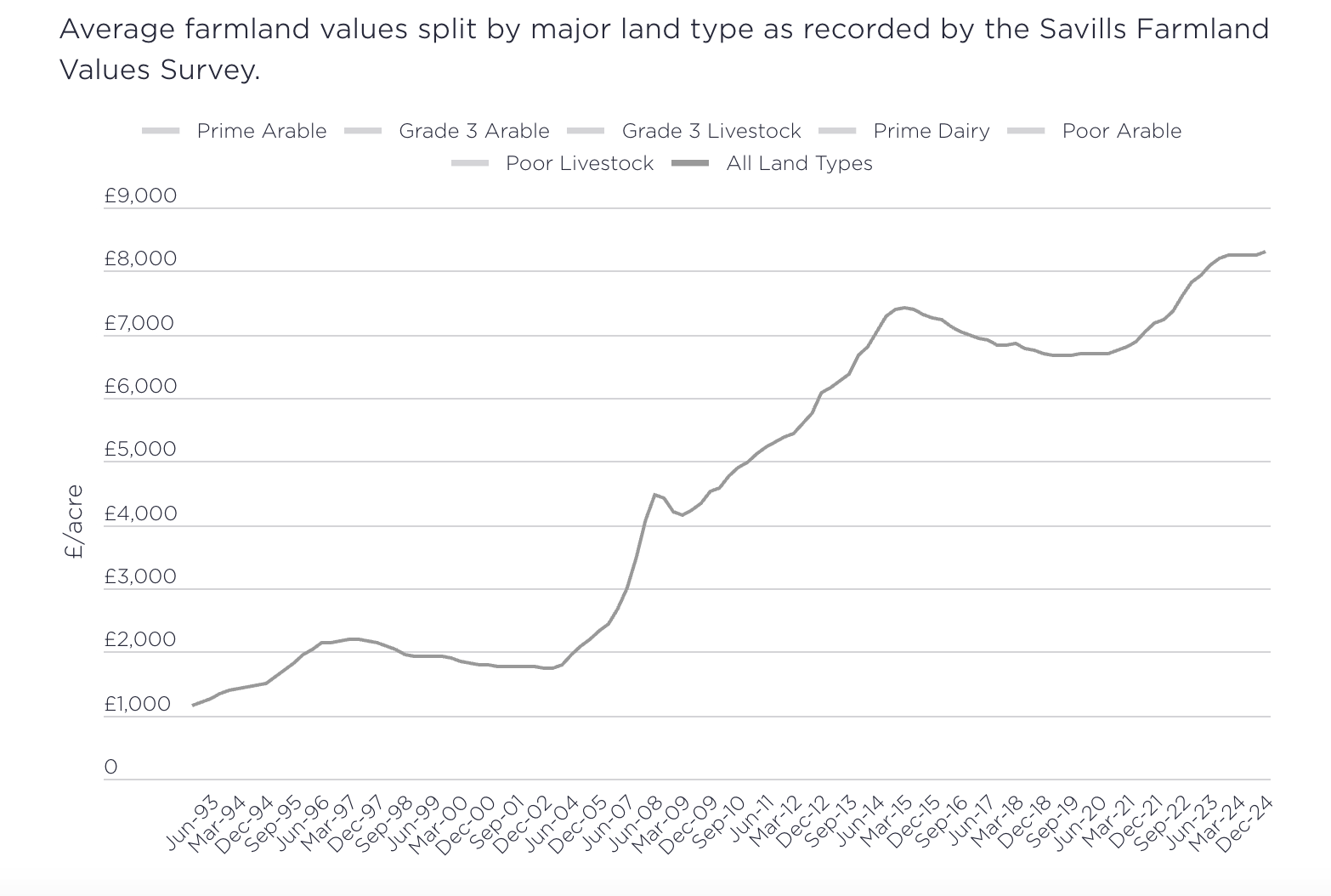
Farmland values have steadily risen since the onset of the neoliberal era, characterised by processes of financialisation. This is Savills’ data for UK farmland prices since the 1990s:
With data for England we can see a bit further back to the onset of the neoliberal era:
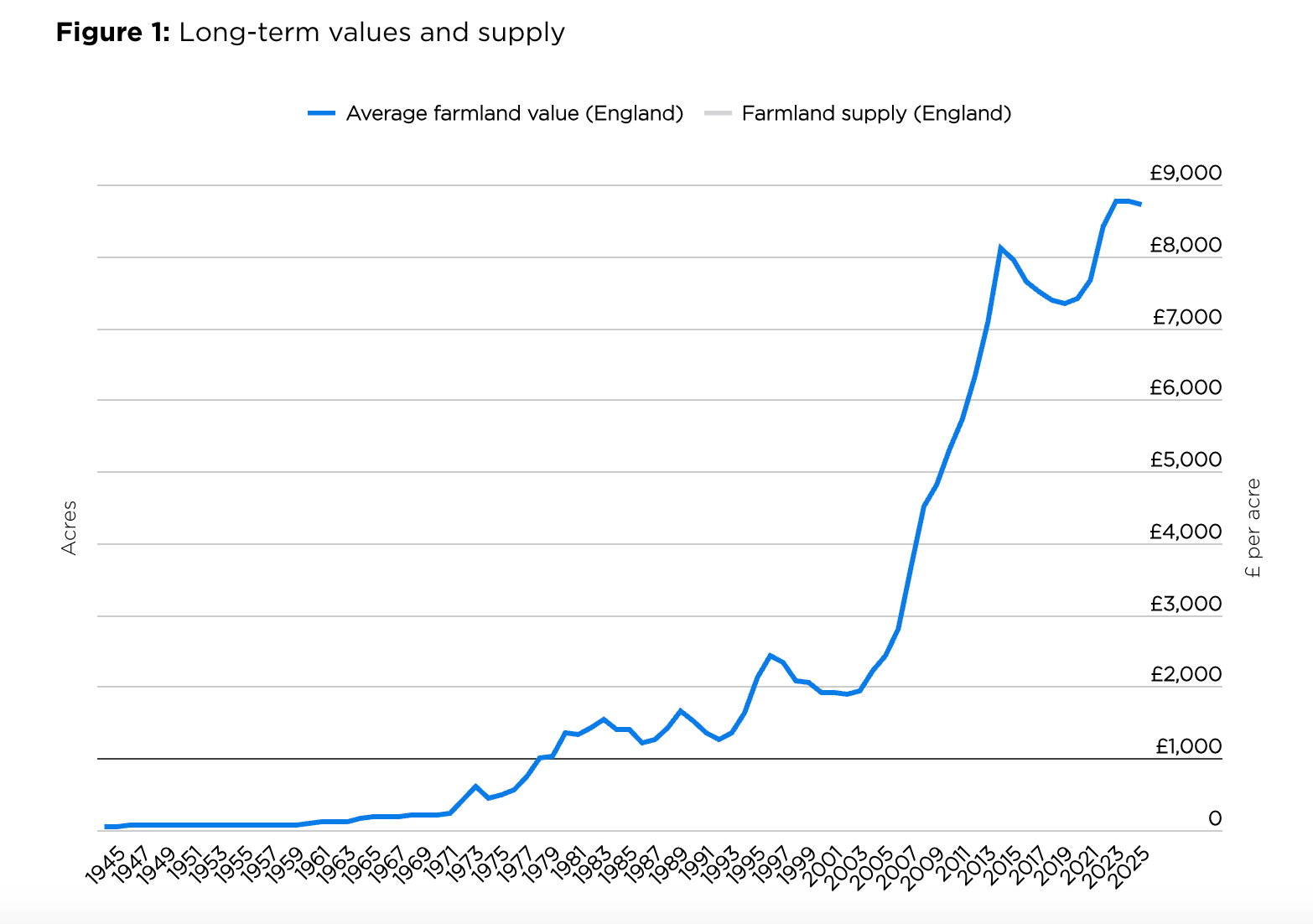
A steady rise in farmland values punctuated by mini peaks and troughs in and around stock market crashes, but generally a consistent valorisation of land, especially this century.
As a representative from Savills states (my emphasis):
Institutional investment capital is increasingly drawn to farmland as a natural capital play, attracted by the multiplicity of land uses and revenue streams that can be stacked on assets, alongside farmland’s history of delivering relatively stable, uncorrelated returns.
Madeleine Fairbairn talks about land being ‘like gold with yield’. The idea being that financial investors move capital into land because it is a safe way to diversify financial portfolios, hedge against risk and to secure an alternative form of return. This amounts to a financialisation of farmland. It brings new landowners, new logics and new pressures. For example, if you need to expand your farm through buying more land it now costs a lot more. It might also mean there is less land available to purchase for farmland expansion. It also brings opportunities for some, including some farmers. My own research is showing that there are farmers who can capitalise upon the influx of fresh finance whether that’s through partnerships, consultancy work, or selling carbon and/or biodiversity credits.
There is currently a growing chorus of voices warning about an impending AI stock market crash. My understanding from listening to a range of voices is that the crash is fairly inevitable but of course no one can predict exactly when or what the trigger will be. It’s not just popular left-wing figures like Grace Blakeley, Cory Doctorow, and Naomi Klein who are bringing attention to the bubble, it’s also financial firms themselves who are at least making references to the need to diversify stocks. Along with forestry, farmland is being identified as a leading choice for owning ‘real’ or ‘hard’ assets as part of a broader trend to invest in ‘natural capital’. For example, JP Morgan, the world’s largest bank, is saying:
After years in which market returns have been increasingly driven by tech, AI and a relatively small group of big companies, many investors are looking for assets driven by something different. That search has renewed interest in hard assets and an investment category known as natural capital.
What they’re looking for is a low level of correlation to the stock market and they see natural capital as having ‘attractive fundamentals’.
The market remains relatively young, but the direction of travel is clear: natural capital is attracting greater interest from institutional investors and asset managers.
That institutionalization is important because ownership of timberland and farmland remains fragmented, with significant amounts still held by families and individuals rather than financial investors. As the market develops, more of these assets may become professionally managed and accessible through investment vehicles.
What they’re saying here is, once finance managers get hold of the land they will be able to construct it as a more accessible asset class for more investors. This means more financialisation of forestry and farmland and by that I mean more of this will come under the power of finance and asset managers. Brett Christophers has called this anti-democratic, oligarchic trajectory ‘asset manager society’ whereby the physical infrastructures needed for the basic survival needs of society come under the control of asset management companies. We need timber, we need food, the result of financialisation or assetisation is that these asset managers are increasingly in charge of this basic provision. And they are primarily motivated by financial returns for investors. Is that what anybody really wants? Has that worked out well with other basic infrastructure? Just look at the state of English rivers.
JP Morgan already has more than $11 billion USD in assets under management globally in forestry alone and this amounts to more than 1.5 million acres of land under their influence. But they’re far from the only ones doing this. This is something I’ve written about before and will be writing more on in the near future. Another example I have found is the South Yorkshire Pension Authority, who, in 2024, partnered with Royal London Asset Management to purchase 20,000 acres of prime farmland in the Cambridgeshire and Lincolnshire fens, for the princely sum of £260 million.
JP Morgan are not alone in showing some consternation over the need to diversify from AI stocks into hard assets, for example, the estate agent, Savills talk about farmland as a:
“HALO” asset: heavy asset, low obsolescence. An asset that offers long-term capital protection, low risk of technological displacement, and resilience to AI disruption.
They see land’s multifunctionality as providing ‘long term capital protection’. UK Farmland prices have plateaued in recent years but it’s hard to see how an AI crash won’t just fuel another surge in farmland prices. Or even just the anticipation of a crash as investment managers seek to hedge against this risk. AI has provided spectacular financial gains, land provides a place of safety, to shelter those returns and still a chance for returns in a more difficult market, should the AI bubble pop.
Do we want farmland in the UK to be continually subject to these speculative pursuits? Do we want finance managers and asset managers to control more of our land? Or do we need better alternatives to capital’s domination? Not just finance capital but capital’s logics as a whole which is what breeds land as both private property and as an asset class, which are two sides of the same coin. The only way to break with the control of finance is to break from the power of capital and construct alternatives.