 Photo: ANTARAVOI | 8 November 2026
Minister of Agriculture prepares the development of 120 thousand acres of garlic with China
JAKARTA - Minister of Agriculture (Mentan) Andi Amran Sulaiman is preparing to develop 120 thousand hectares (ha) of garlic through cooperation with China to strengthen the self-sufficiency of the commodity.
"We just came back from Beijing, met the Chinese Minister of Agriculture, a long discussion. We will work together in the future to strengthen food, because the world is again in a food crisis," said the Minister of Agriculture on the sidelines of a press conference on agricultural issues in Jakarta, Sunday, quoted by Antara.
Amran said that the cooperation had been discussed with the Chinese Minister of Agriculture Zhang Zhu as a step to strengthen food security, one of which was a collaboration on the development of garlic, starting from the provision of seeds to the development of cultivation in Indonesia.
Garlic seeds will be supplied from China as the initial part of the collaboration, while the government is preparing technical follow-up so that development can continue and gradually increase national production.
According to Amran, the cooperation is not only aimed at meeting the needs of Indonesia and China, but also directed at producing competitive garlic to enter the global export market later.
Minister of Agriculture (Mentan) Andi Amran Sulaiman (center) accompanied by Deputy Minister of Agriculture (Wamentan) Muhammad Saleh Mustafa (second right), Deputy Minister of Agriculture (Wamentan) Alim Setiawan Slamet (second left), President Director of Perum Bulog Ahmad Rizal Ramdhani (right) and other officials, gave information to the media in Jakarta, Sunday (8/11/2026). ANTARA/Harianto.
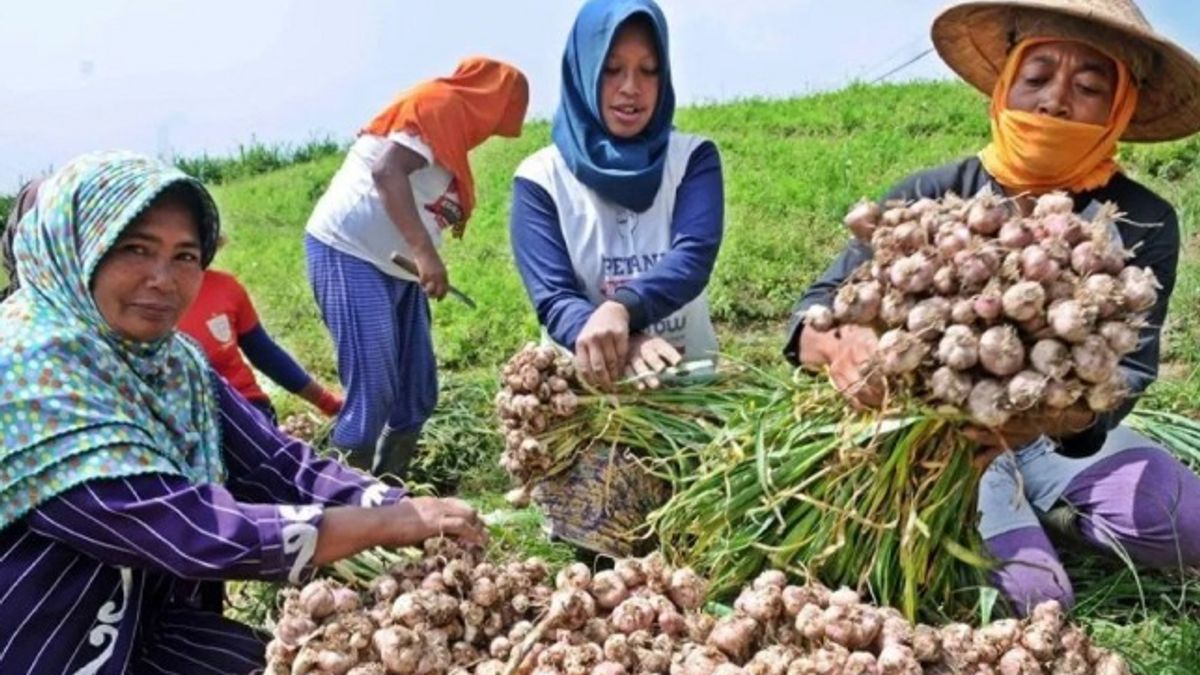
The government is planning to develop garlic in the Sembalun area, Temanggung, as well as a number of areas in Sumatra which are considered to have the right agroclimatic conditions to support increased national production.
The total development reaches 120 thousand hectares as part of the strategy to strengthen the self-sufficiency of garlic and reduce import dependence through the sustainable increase in domestic production capacity.
Amran added that the follow-up to the implementation of cooperation would be coordinated by two of his deputies, namely Deputy Minister of Agriculture Muhammad Saleh Mustafa, and Deputy Minister of Agriculture Alim Setiawan Slamet, so that all stages of development would be effective, from seed provision to cultivation implementation in the field.
"(The expansion area) is 120 thousand hectares. There is Wamen 2 (Deputy Minister of Agriculture Alim Setiawan Slamet) who will follow up, he is a former rector, lecturer, smart, still young. Mr. Wamen 1 (Deputy Minister of Agriculture Muhammad Saleh Mustafa) is also smart, agile, still young. So the minister is calm," said Amran.
Previously, Minister of Agriculture Andi Amran Sulaiman and Chinese Minister of Agriculture Zhang Zhu agreed to strengthen agricultural cooperation to increase production, technology transfer, investment, and the development of strategic commodities to strengthen the production capacity of both countries.
The agreement was made during a bilateral meeting between Minister of Agriculture Amran and Chinese Minister of Agriculture Zhang Zhu, in Beijing, Monday (2/11).
The meeting discussed the development of garlic from upstream to downstream, collaboration in research and modern agricultural technology, strengthening trade in flagship commodities, and investment opportunities in the processing industry.
It is known that President Prabowo Subianto targets Indonesia to achieve self-sufficiency in garlic in the next three years after the government has succeeded in realizing self-sufficiency in eight food commodities in the past year.
"We are still not self-sufficient in garlic, we are struggling so that in three years we can achieve self-sufficiency in garlic," said Prabowo in the Annual Meeting of the Indonesian People's Consultative Assembly and the Joint Meeting of the Indonesian House of Representatives and the Indonesian DPD at the Parliament Complex, Jakarta, Friday (14/8).
As for the 11 strategic food commodities that are of concern to the government, eight commodities have achieved self-sufficiency, including rice, corn, consumer sugar, purebred chicken meat, purebred chicken eggs, red onions, large chilies, and sweet peas.
Currently, the government through the Ministry of Agriculture is still pursuing self-sufficiency for three other staple commodities out of a total of 11 national basic needs, including soybeans, beef, including garlic.