 AIM | 20 October 2026
BNDES Climate Fund commits R$250M to Belterra for 4,000-ha cocoa agroforestry development
By Lynda Kiernan-Stone
The Brazilian Development Bank (BNDES), announced it is committing R$250 million (US$50 million) through its Climate Fund for Belterra, a forest restoration specialist focused on the implementation and management of agroforestry systems, to develop 4,000 hectares of degraded land in the Amazon to agroforestry-based cocoa production.
The investment will be concentrated in the widely known Amazon Restoration Arc, a region that encompasses areas historically negatively affected by deforestation and the conversion of forest into pastures and low-productivity agricultural activities.
Located mainly in Pará, with operations also in Mato Grosso, the initiative, which will be carried out by Restaura Amazônia SPE SA, a company of the Belterra Group,will combine environmental recovery, sustainable cocoa production, and income generation in rural communities.
“We are financing an important transformation in the Amazon: degraded areas, which today have low productivity, will become productive forests, generating jobs, income and helping to address climate change,” said Aloizio Mercadante, president, BNDES.
“With R$250 million from the Climate Fund, we will support the recovery of 4,000 hectares and strengthen the sustainable production of cocoa. It is an investment that shows how Brazil can reconcile environmental preservation, economic development, and the expansion of agricultural production, without having to encroach on the forest.”
The Project
Employing agroforestry systems that combine native trees intermixed with agricultural crops, the partners expect to plant approximately 4.72 million seedlings before development is completed in 2031.
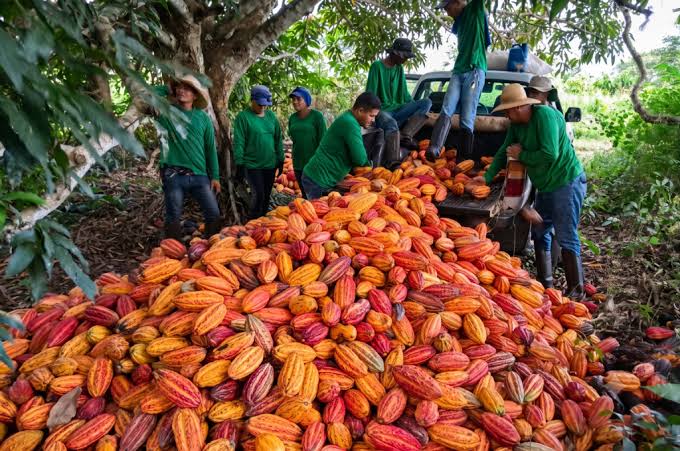
In total, 25 native species are planned, each with different environmental and productive functions, whether that be soil restoration, providing shade, protecting biodiversity, or serving as new income streams for farmers. Alongside these species, cocoa will be the main crop, however açaí, Brazil nut, andiroba, ingá, ipê, jatobá, and paricá, as well as shorter-cycle crops like bananas and cassava, will also be included.
Ultimately, the project aims to rehabilitate land without requiring the owner to abandon their activity. Rather, the proposal aims to partner with rural landowners to replace unproductive systems with tree cover, highest-use agricultural production, and greater carbon storage.
Belterra will fund the initial implementation investment covering seedlings, supplies, technical assistance, training in agroforestry practices, and labor without requiring financial contribution from the partner farmer.
Contracts may follow a lease or rural partnership model. In the case of the latter, producers receive a fixed remuneration during the first three years before commercial cocoa production begins. After the harvest starts, they will receive a share of the production, participating in the results of the activity.
Once underway, expectations are that cocoa output could exceed 12,000 tons per year, reducing Brazil’s dependence on imports and strengthening the country’s chocolate supply chain, while removing around 337,000 tons of carbon dioxide equivalent (CO₂e), and increasing the number of direct jobs and service providers to 960 after completion.
“The project shows that forest restoration can also be a concrete opportunity for income generation for rural producers,’ said Tereza Campello, socio-environmental director, BNDES.
“We are supporting a model that combines native trees with the production of cocoa and other crops, recovering soil fertility, and making agricultural activity more sustainable. The producer gains technical assistance, access to markets, and new income opportunities.”
The project will also include investments allocated to expand nurseries, install irrigation systems, acquire new farming machinery, and develop infrastructure for cocoa fermentation and drying.
Belterra noted that it maintains a long-term offtake contract with a global cocoa and chocolate company for the purchase of cocoa from the project with an initial term of 15 years, thus reducing exposure to volatility and risk for both the growers and the company.
Belterra also intends to obtain certification for the generation of carbon credits associated with the recovered areas. This activity could represent a complementary source of revenue, contingent upon project validation, removal certification, and market conditions.
“BNDES support allows us to take a new leap in scale and reinforces Belterra’s growth strategy,” said Valmir Ortega, CEO, Belterra Agroflorestal.
“We are building a new productive base for Brazilian cocoa, in partnership with the chocolate industry and producers from the Amazon and the Atlantic Forest, transforming degraded areas into agroforestry systems that generate income, jobs, and standing forest. Each hectare recovered is a hectare that returns to production, generating income and harboring biodiversity.”